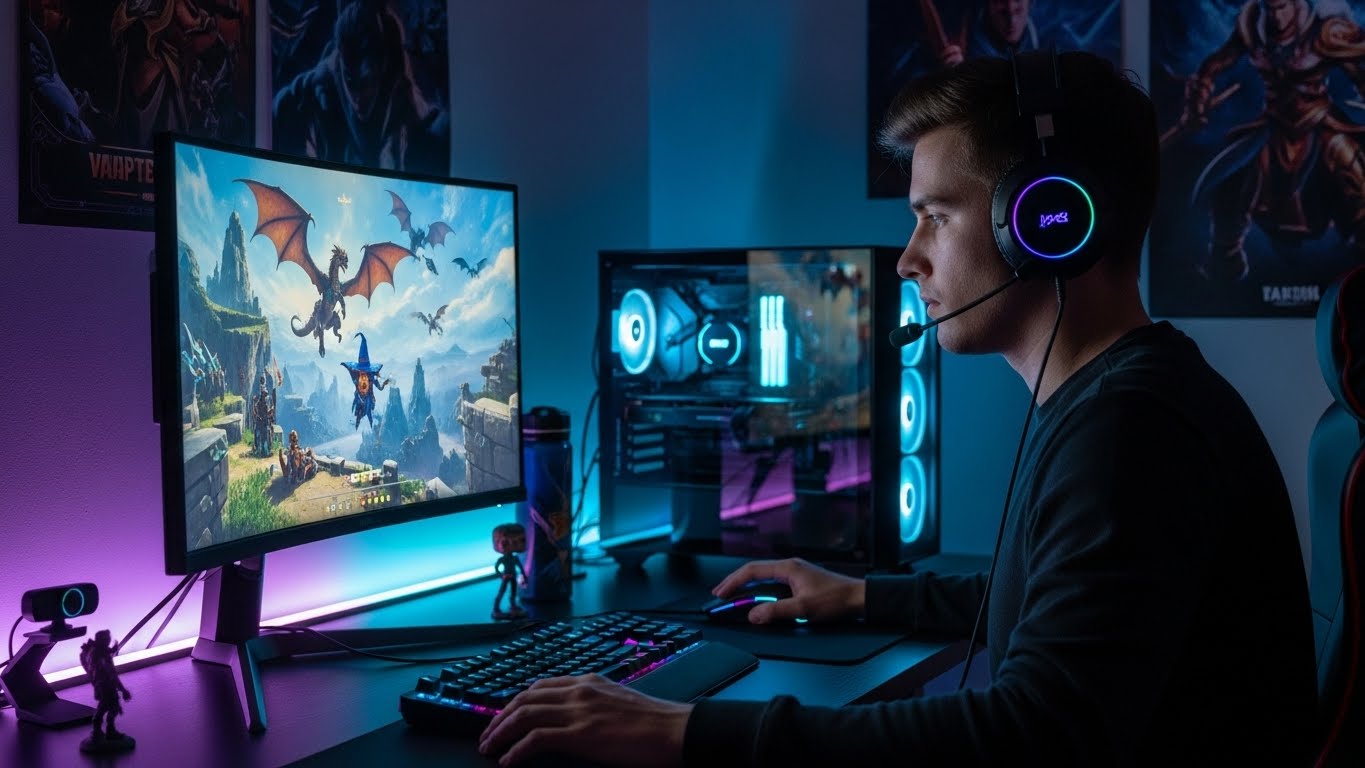

Gaming is no longer just a pastime; it has evolved into a global cultural force. What started as simple arcade machines and home consoles has transformed into an immersive world where players can experience new realities, connect with others, and push the boundaries of creativity. From solo adventures to vast multiplayer universes, gaming continues to shape our digital landscape in profound ways. This blog post delves into how gaming has evolved and why it has become such an integral part of modern culture.
The Early Days: From Arcades to Home Consoles
The journey of gaming began in the 1950s and 1960s with experiments designed to push the limits of technology. Early games like Spacewar! and Tennis for Two were crude by today’s standards but laid the foundation for what would become a worldwide entertainment industry.
In 1972, Atari introduced Pong, the first commercially successful video game. It was a simple two-player ping-pong game displayed on a black-and-white screen, yet it captivated players and signaled the beginning of the video game era. The arcade boom followed quickly, with Space Invaders and Pac-Man becoming household names in the late 70s and early 80s. These games, with their straightforward mechanics and colorful designs, had an immediate cultural impact, sparking the rise of arcade gaming as a social experience.
By the mid-1980s, home consoles entered the picture, making video games more accessible to people around the world. The release of the Nintendo Entertainment System (NES) in 1985 was a game-changer. It introduced the world to beloved characters like Mario and Zelda, revolutionizing gaming from a casual activity to a full-fledged home entertainment experience. As consoles became more powerful, the demand for higher-quality games with deeper storylines and more complex mechanics grew.
The Golden Age of 3D Gaming
The 1990s marked a significant turning point in the world of gaming. With the arrival of the Sony PlayStation in 1994 and the Nintendo 64 in 1996, the gaming landscape shifted from 2D sprites to fully rendered 3D worlds. These consoles allowed developers to create expansive game environments that players could explore in entirely new ways.
The impact of 3D gaming cannot be overstated. Super Mario 64 revolutionized platformers, and The Legend of Zelda: Ocarina of Time set new standards for open-world games. These games introduced new dimensions of freedom and interaction, making players feel like they were stepping into another world. At the same time, the PlayStation introduced story-driven games like Final Fantasy VII and Metal Gear Solid, which proved that video games could be a serious medium for storytelling.
The rise of 3D also spurred the development of the first truly immersive game genres, from first-person shooters like GoldenEye 007 to racing games like Gran Turismo. Gaming had evolved from being a simple form of entertainment to a dynamic, interactive medium capable of offering complex narratives, intense competition, and realistic simulations.
The Explosion of Online Gaming and Esports
As the internet began to take hold in the late 1990s and early 2000s, online gaming took off. Games like StarCraft and Warcraft allowed players to connect and compete with each other across vast distances. This new era of multiplayer gaming led to the rise of massively multiplayer online role-playing games (MMORPGs) like World of Warcraft, which created expansive virtual worlds where players could socialize, collaborate, and embark on epic quests together.
The early 2000s saw the launch of online services like Xbox Live and PlayStation Network, which brought online multiplayer gaming to consoles, further expanding the reach of gaming. Halo 2 and Call of Duty 4: Modern Warfare were among the games that pioneered online competitive play, building communities around team-based combat and ranking systems.
Esports, or competitive gaming, has grown to become a multi-billion-dollar industry. Major tournaments like The International (for Dota 2) and League of Legends World Championships attract millions of viewers worldwide. The professionalization of gaming has not only created new career opportunities but has also brought gaming into the mainstream, with professional players, teams, and sponsors.
The Mobile Gaming Revolution
In the last decade, the rise of smartphones has had a profound effect on the gaming world. Mobile gaming, once considered a niche market for casual gamers, has exploded into a major industry. Games like Angry Birds, Candy Crush Saga, and Clash of Clans became massive hits, attracting millions of players from all walks of life. Mobile gaming is characterized by its accessibility, with users able to play on the go and at their own pace, whether during commutes or short breaks.
The accessibility of mobile gaming has also allowed developers to experiment with new formats and business models. Free-to-play games with in-app purchases have become a dominant model, allowing players to enjoy games without upfront costs while giving developers a sustainable revenue stream. Mobile gaming also introduced the concept of “games as a service,” where developers continuously update and improve their games, providing new content and experiences long after the game’s initial release.
While mobile gaming started with simple, easy-to-play titles, the evolution of smartphones has enabled more complex and graphically intense games, such as PUBG Mobile and Genshin Impact. These games bring console-quality experiences to handheld devices, expanding the possibilities for mobile gaming even further.
The Rise of Virtual Reality and Augmented Reality
Looking toward the future, virtual reality (VR) and augmented reality (AR) are poised to revolutionize gaming once again. With VR headsets like Oculus Rift and PlayStation VR, players can fully immerse themselves in digital worlds, where they can interact with the environment in ways that traditional gaming never allowed. VR promises to provide an unprecedented level of immersion, where players feel like they are truly inside the game.
Games like Beat Saber and Half-Life: Alyx have shown the potential of VR to create engaging, interactive experiences. These games offer not just visual experiences, but also physical interaction, where players use motion controllers to slice, shoot, and explore virtual spaces.
Meanwhile, AR, which overlays digital elements onto the real world, has also begun to make waves in gaming. Pokémon GO, for example, brought the world of Pokémon into the real world, encouraging players to go outside and explore their environment while interacting with digital creatures. As the technology behind VR and AR continues to improve, we are likely to see even more immersive and interactive games that blur the lines between the physical and digital worlds.
Gaming’s Impact on Society and Culture
Gaming is no longer just about playing; it’s about community, culture, and even education. Platforms like Twitch and YouTube have transformed gaming into a spectator sport, where players can watch others play and interact with them in real-time. The rise of live streaming has given birth to a new generation of gaming influencers who can reach millions of viewers, making gaming a more social activity than ever before.
Additionally, video games have become an important tool in education and learning. Games like Minecraft and Kerbal Space Program are used in classrooms to teach everything from creativity and design to engineering principles. The immersive nature of games allows players to learn by doing, creating a hands-on learning experience that textbooks alone can’t replicate.
Gaming has also become a reflection of societal trends and issues. Games like The Last of Us Part II and Detroit: Become Human tackle themes such as identity, morality, and survival, offering players a chance to engage with complex narratives that mirror real-world dilemmas. As gaming continues to evolve, its potential to inspire conversation and promote social change is immense.
The Future of Gaming: Endless Possibilities
The future of gaming looks bright. As technology advances, so too will the possibilities within gaming. With cloud gaming services like Google Stadia and Xbox Game Pass, players no longer need expensive hardware to access high-quality games. Instead, they can stream games directly to their devices, further democratizing access to gaming and allowing anyone with an internet connection to play.
Moreover, artificial intelligence and machine learning are opening new doors for dynamic, responsive game worlds. AI could create more realistic, unpredictable NPCs, or even generate unique storylines based on a player’s choices. The concept of “procedural generation” is already being used to create expansive, ever-changing worlds, as seen in games like No Man’s Sky.
The possibilities for the future of gaming are endless. With the rise of AI, cloud gaming, and immersive technologies like VR and AR, the gaming world is set to continue evolving in exciting and unexpected ways. Whether it’s connecting with others in a digital world, exploring new realities, or learning something new, gaming has proven that it is more than just a hobby—it is a powerful, transformative medium that will continue to shape our digital future.
Conclusion: Gaming’s Role in Modern Life
From its early days in arcades to the rise of online multiplayer, mobile gaming, and VR, gaming has come a long way. Today, it plays a central role in entertainment, education, and social interaction. It’s a platform for creativity, a means for global connection, and an immersive escape that allows players to experience new worlds and stories.
As gaming continues to evolve, it will undoubtedly remain a key driver of innovation, bringing people together and pushing the boundaries of what we thought possible in digital entertainment. The future of gaming is filled with infinite possibilities—what’s next is an adventure we’ll all take part in.