
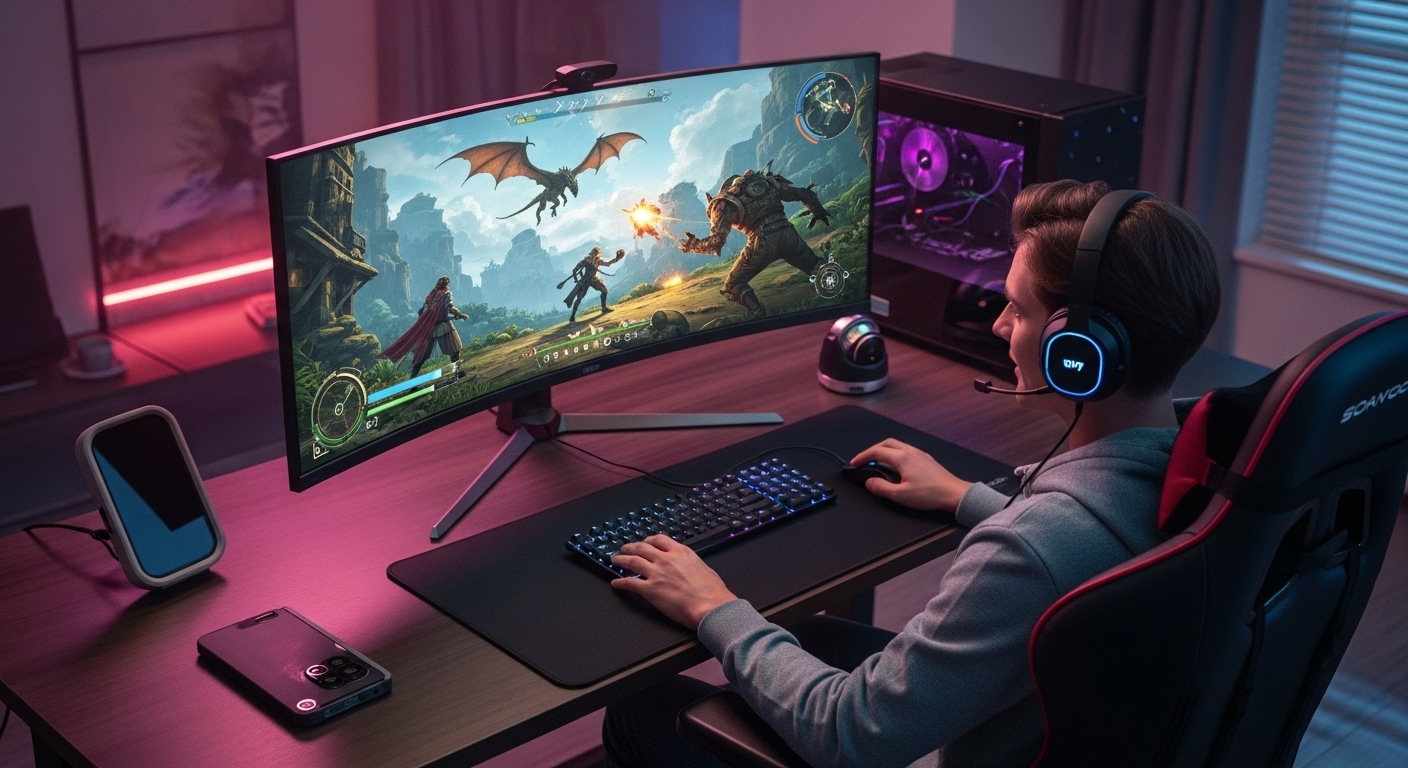
Introduction: A World Transformed by Gaming
Gaming has become an integral part of global culture, an activity that transcends age, gender, and nationality. What began as a niche hobby for enthusiasts has grown into a multi-billion-dollar industry that shapes the way people connect, entertain, and even think. With the rapid pace of technological innovation, gaming is constantly evolving, offering new experiences that blend storytelling, interactivity, and immersion in ways never seen before.
The journey of gaming—from its humble beginnings in the arcades to the immersive virtual worlds of today—offers a fascinating look at how this form of entertainment has influenced not only technology but also society as a whole. This blog will explore the transformation of gaming, the impact it has had on culture, and where the industry is headed in the future.
The Early Days of Gaming: Simplicity and Innovation
The origins of modern gaming can be traced back to the 1950s and 1960s when early computer experiments produced rudimentary games. These were often used as demonstrations of the computing power of early machines. One of the earliest known video games was Tennis for Two, created by physicist William Higinbotham in 1958. It was a simple game that allowed players to control a dot representing a ball on an oscilloscope screen. Though basic, it laid the foundation for what would eventually become a billion-dollar industry.
However, it wasn’t until 1972 that gaming as we know it today began to take shape with the release of Pong, an arcade game created by Atari. Pong was a simple simulation of table tennis, where players controlled paddles to hit a ball back and forth. While the game itself was straightforward, its impact on the industry was monumental. Pong was the first commercially successful video game and marked the beginning of the arcade gaming era. It was the first glimpse of the entertainment potential that video games would soon offer.
Following the success of Pong, other arcade games like Space Invaders, Asteroids, and Pac-Man soon followed. These games were simplistic, yet engaging, providing players with an interactive experience that was previously unavailable. Arcade culture became a massive part of social life, with people flocking to local arcades to compete for high scores and socialize with others.
The Rise of Home Consoles: Gaming at Your Fingertips
By the late 1970s and early 1980s, video games had started to gain significant popularity, and the concept of home gaming consoles emerged. The Atari 2600, released in 1977, was one of the first successful home consoles, bringing arcade games into living rooms. For the first time, players could enjoy video games without needing to visit an arcade. The ability to purchase cartridges and switch between games made the system a popular option for families.
Home gaming took another leap forward with the release of the Nintendo Entertainment System (NES) in 1985. The NES revolutionized the industry by introducing classic games like Super Mario Bros., The Legend of Zelda, and Metroid, which became iconic franchises. The NES also set the stage for a more immersive, narrative-driven approach to gaming, with side-scrolling platformers and action-adventure titles that emphasized exploration and story.
The 1990s saw the emergence of 3D graphics, further expanding the possibilities of game design. The Sony PlayStation, released in 1994, brought home consoles into the 3D era with groundbreaking titles like Final Fantasy VII, Gran Turismo, and Crash Bandicoot. These games featured fully rendered 3D worlds, complex narratives, and intricate character development, showing that video games could be just as deep and immersive as any form of traditional entertainment.
The Internet Age: Online Gaming and Social Connectivity
The late 1990s and early 2000s marked a major shift in gaming as the internet became more widely accessible. Online multiplayer games allowed players to connect with each other across the globe, creating a new dimension of social interaction within the gaming world. Diablo II, released in 2000, was one of the first games to feature online play through Battle.net, Blizzard’s online service. Players could team up with others or face off in player-versus-player battles, introducing the concept of online communities and competitive play.
One of the most significant milestones in online gaming was the release of World of Warcraft in 2004. WoW, a massively multiplayer online role-playing game (MMORPG), allowed players to enter a massive, persistent online world where they could complete quests, fight monsters, and interact with other players in real-time. WoW became a cultural phenomenon, attracting millions of subscribers and fostering a sense of community among players. It also popularized the concept of raiding, where large groups of players would work together to defeat difficult in-game bosses, a feature that continues to be central in many modern MMORPGs.
The Mobile Gaming Revolution: Gaming for Everyone
In the 2000s, mobile phones began to evolve, offering more powerful hardware and, most importantly, the ability to run games. This shift marked the birth of mobile gaming, which brought gaming to a whole new audience. In 2008, Apple’s App Store opened up a whole new world of gaming possibilities, allowing developers to create and distribute games directly to smartphones and tablets.
Mobile games like Angry Birds, Candy Crush Saga, and Clash of Clans quickly became household names, offering players quick, accessible gaming experiences. These games often rely on simple mechanics that are easy to learn but difficult to master, making them highly addictive and perfect for short bursts of play. The success of mobile games was also due in part to their accessibility—players no longer needed to invest in expensive consoles or PCs to enjoy gaming; all they needed was a smartphone.
As mobile gaming grew, it began to cater to a more diverse demographic, including older players, casual gamers, and those new to the gaming world. The accessibility and low cost of mobile games helped them become an essential part of modern entertainment, contributing significantly to the overall gaming industry’s growth.
The Era of eSports: Competitive Gaming Goes Global
In the past decade, eSports, or competitive video gaming, has emerged as a cultural and financial powerhouse. The rise of streaming platforms like Twitch and YouTube Gaming has made it possible for fans to watch professional gamers compete in real-time. Competitive gaming tournaments like The International for Dota 2, the League of Legends World Championship, and the Fortnite World Cup offer millions of dollars in prize money, drawing massive live audiences and even larger online viewerships.
eSports has turned gaming into a spectator sport, with professional players and teams now being treated like athletes. Many competitive gamers have sponsors, trainers, and coaches, and some even make their living from tournament winnings and streaming. The eSports industry has grown so large that it now holds televised events in major arenas, such as the Staples Center in Los Angeles and Arthur Ashe Stadium in New York, further cementing gaming as a mainstream form of entertainment.
Virtual Reality and Augmented Reality: The Next Frontier
Looking ahead, the future of gaming appears to be in virtual reality (VR) and augmented reality (AR). While VR has been around for some time, it’s still in its infancy in terms of mass adoption. Devices like the Oculus Rift and PlayStation VR are bringing immersive gaming experiences to players, offering fully realized 3D worlds that players can explore by moving their bodies and using specialized controllers.
In VR games, players can physically interact with the environment in a way that traditional gaming simply cannot replicate. Games like Beat Saber and Half-Life: Alyx have already showcased the potential of VR gaming, creating truly immersive experiences that draw players into the game world. As technology advances, VR is likely to become more refined, with better graphics, improved motion tracking, and more intuitive controls, making it a central part of the future of gaming.
At the same time, augmented reality (AR) is also becoming a major focus for game developers. Games like Pokémon GO have already demonstrated how AR can blend the real world with digital elements, allowing players to interact with virtual objects in real-life locations. As AR technology continues to improve, we may see new games that offer unique, location-based experiences or games that allow players to augment their physical environment with digital content.
Conclusion: Gaming’s Ever-Expanding Horizon
From its early days in arcades to the immersive worlds of virtual reality, the journey of gaming has been nothing short of extraordinary. Today, gaming is more than just a form of entertainment; it’s a powerful cultural force that shapes the way we connect with one another, express creativity, and experience stories. The future of gaming looks bright, with new technologies and trends continuing to push the boundaries of what is possible.
Whether through the rise of eSports, the growth of mobile gaming, or the immersive possibilities of VR and AR, the gaming industry will continue to evolve and surprise us. As technology continues to advance, it’s clear that gaming will remain at the forefront of digital entertainment for years to come, offering new ways to explore, compete, and connect with others.